The European Conference on Educational Research (ECER 2026) was held in Tampere, Finland, in August 2026 under the theme “Knowing and Acting: The Changing Conditions and Potentials of Education Research.” Arctic perspectives on education, sustainability, Indigenous knowledge, and art education were strongly represented throughout the conference, with several presentations connected to the international collaboration fostered through the University of the Arctic (UArctic) and its Arctic Sustainable Arts and Design (ASAD) network.
Sámi education and ecologies of knowledge
The conference opened with a keynote by Professor Pigga Keskitalo from the University of Lapland, titled “Ecologies of Knowledge and the Future of Teaching: Sámi Education in Times of Transition.” The keynote explored how Sámi education, grounded in Indigenous knowledge systems, intergenerational responsibility, and cultural continuity, can offer important perspectives for the future of teaching and learning.
Drawing on the concept of ecologies of knowledge, the keynote highlighted the coexistence and interdependence of multiple ways of knowing, including spiritual, embodied, Land-Based, oral, linguistic, and experiential forms of knowledge rooted in particular places, histories, and communities. The keynote provided an important foundation for several presentations by members of the ASAD network and Maria Huhmarniemi, UArctic Chair in Arctic Art and Design.
Arctic collaboration in teacher education
Annamari Manninen from the University of Lapland, together with Karin Stoll, Wenche Sørmo, and Mette Gårdvik, contributed by “Arctic Teacher Education in Collaboration: Creating Dialogues for Learning with Art, Science and Communities.” The presentation discussed a shared hybrid university course in Arctic Art Education for teacher students from Sweden, Norway, Finland, and Greenland.
The collaboration seeks to create dialogue between Arctic communities, children and young people, teacher students, university professors, and local actors in the cultural and educational fields. The participating universities integrate contemporary art practices with Northern knowledge and traditions, creating opportunities to explore sustainability issues from the perspectives of Arctic communities and places. The initiative is part of the UArctic-funded Northern Connections project.
Comfortable Learning
Kathryn Burnett from the University of the West of Scotland, Elina Härkönen from the University of Lapland, and Lotta Lundstedt from Umeå University presented “‘Getting it’ Together: Reflecting on Art Education Practice as Collaborative Conversations and ‘Comfort-able’ Learning.”
The presentation reflected on pedagogical collaboration in a Northern European, Arctic, and near-Arctic context. Drawing on international exchange within the UArctic ASAD network, the authors examined reflexive, embodied, and material forms of collaboration in higher arts education. Their approach emphasises learning as a process of coming together across regional contexts, with attention to care, agency, negotiation, and the creation of supportive learning environments.
Reflecting changes in Sápmi through art
Mirja Hiltunen and Korinna Korsström-Magga from the University of Lapland presented “Rievdan – Reflecting Changes in Sápmi Through Art.” Rievdan, meaning “change,” is a two-year arts-based action research project that foregrounds Indigenous worldviews and epistemologies in the North.
The project explores how artistic expression can support community resilience by enabling local perspectives to be articulated and communicated to broader audiences and decision-makers. Funded by the Kone Foundation and the University of Lapland, the project forms part of the Faculty of Art and Design’s development work in transformative Arctic art education.
Young people’s future imaginaries through collaborative filmmaking
Suvi Autio from the University of Lapland presented “With the Land’s Voice and Ours: Arts-based Action Research on Future Imaginaries through Collaborative Filmmaking.”
The research examines films created collaboratively by Indigenous youth in northern contexts and explores how young people’s images of the future can function as both research material and pedagogical practice. The study draws on media art workshops at a Sámi upper secondary school in Utsjoki, Finland, and at Inussullivik in Narsaq, Greenland. The films explore young people’s relationships with Land, ecocultures, and cultural continuity. The Greenland workshop was carried out through collaboration within the ASAD network.
Three posters on Arctic art education and sustainability
Maria Huhmarniemi, UArctic Chair in Arctic Art and Design, was also a co-author of three posters presented at the conference. The posters extended the discussion of Arctic art education towards decoloniality, interdisciplinary art–science education, and eco-cultural sustainability.
New Genre Arctic Art Education in Nordic Countries: Results of Art-Based Action Research
The poster by Timo Jokela, Mirja Hiltunen, and Maria Huhmarniemi examined the development of Arctic art education in northern Finland, Norway, and Greenland.
The authors discuss the historical influence of Western art education traditions in the European Arctic and the ways in which these traditions have contributed to external representations of the North and reproduced colonial power relations. The research frames Arctic art education through decolonial theory, eco-cultural perspectives, and the principle of two-eyed seeing. It proposes New Genre Arctic Art Education as a relational, place-based, and epistemologically plural approach in which learning emerges through relationships among learners, educators, materials, places, and cultural contexts.
Interdisciplinary Art and Science Education in the European Arctic Context
Maria Huhmarniemi and Xiaowei Zhang presented research on interdisciplinary art and science education in the European Arctic. The study explores how hands-on engagement with natural materials can connect cognitive, emotional, and sensory dimensions of environmental learning. Based on arts-based action research, the study includes pedagogical experiments using local ecological materials, including bilberries and their chemical transformations, to connect visual arts practices with chemistry learning. The findings highlight the potential of visual arts to support observation, material engagement, visual meaning-making, and holistic learning in sustainability education.
Art-Based Eco-Cultural Animation for Environmental and Sustainability Education in a Time of Poly-Crisis
A third poster by Maria Huhmarniemi and Timo Jokela explored the development of art-based eco-cultural animation as an approach to environmental and sustainability education. The research responds to the interconnected challenges of climate change, biodiversity loss, inequality, and cultural transformation. It builds on sociocultural animation and connects participatory artistic practices with community art, place-based art, and environmental art education in Northern Finland and the European Arctic. The approach emphasises cultural continuity as well as the renewal of local ecocultures in response to ecological crises.
Power of Networks
Together, these contributions demonstrate the breadth of current Arctic art education research and the importance of international collaboration across the Arctic and near-Arctic regions. The presentations brought together Indigenous and Western ways of knowing, arts-based research, teacher education, sustainability education, and place-based pedagogies.
The strong presence of Arctic perspectives at ECER 2026 also highlights the role of international networks such as UArctic and ASAD in creating spaces for knowledge exchange, collaborative research, and new approaches to art education in the North.
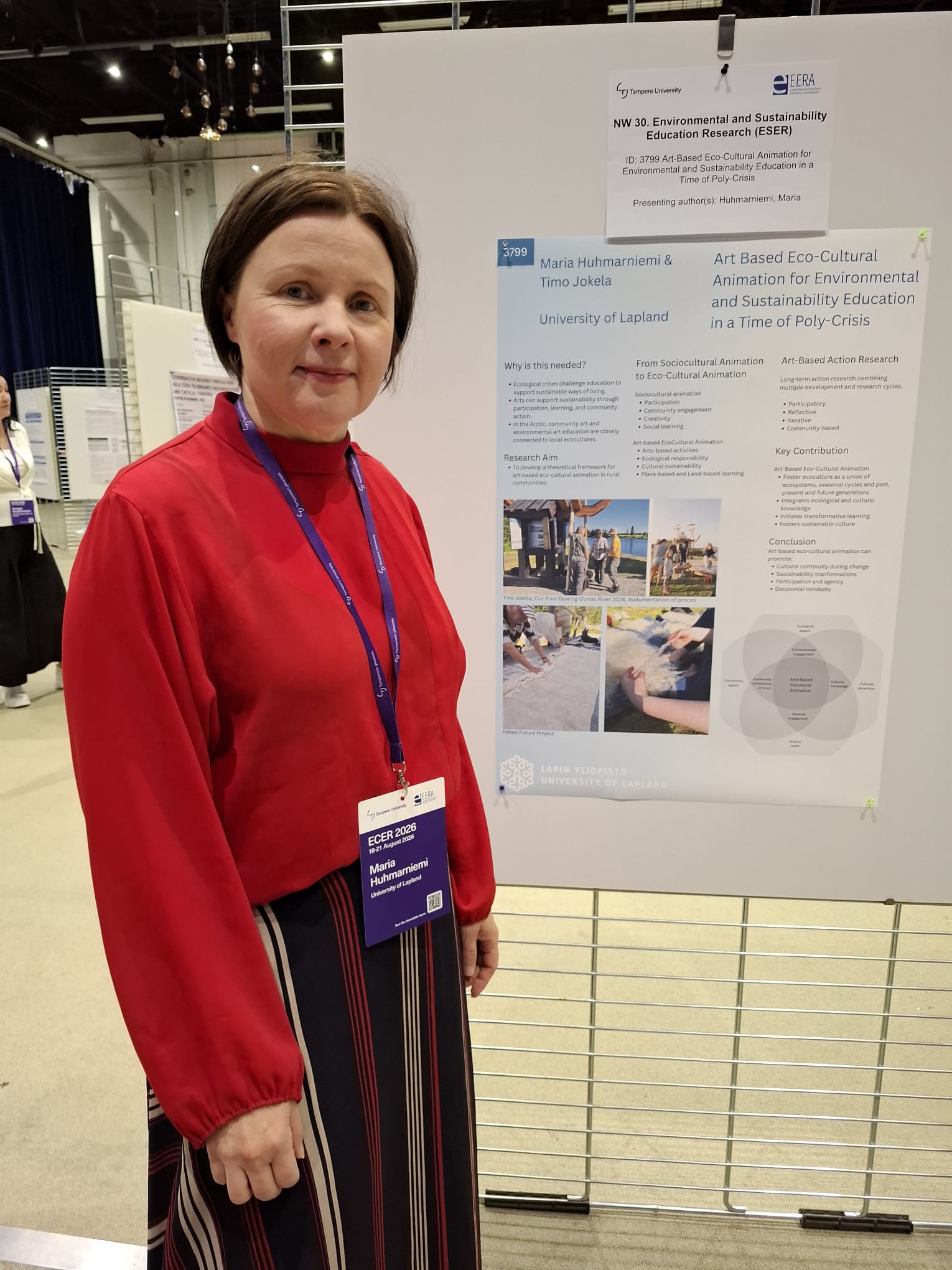
Maria Huhmarniemi
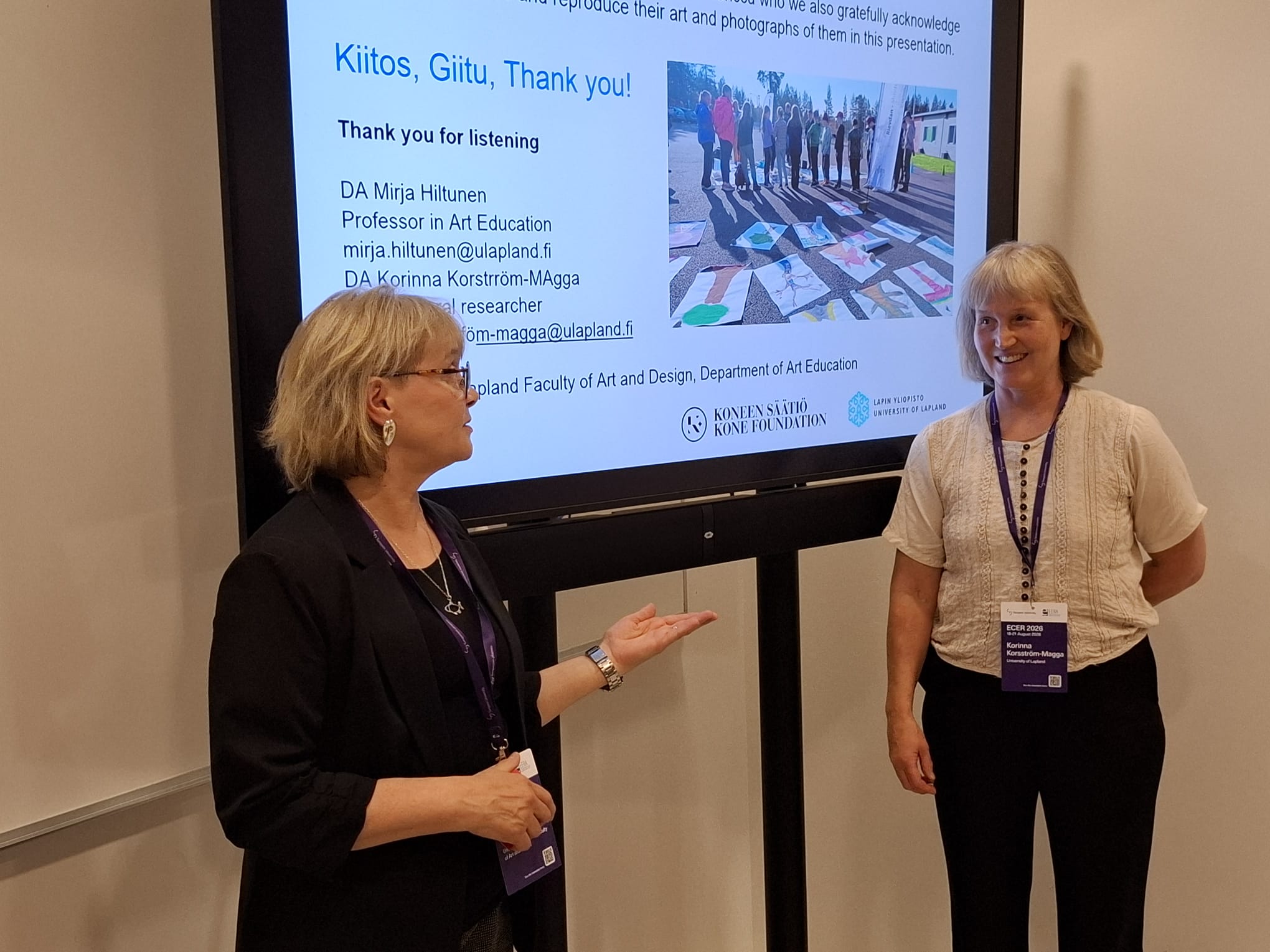
Mirja Hiltunen and Korinna Korsström-Magga.